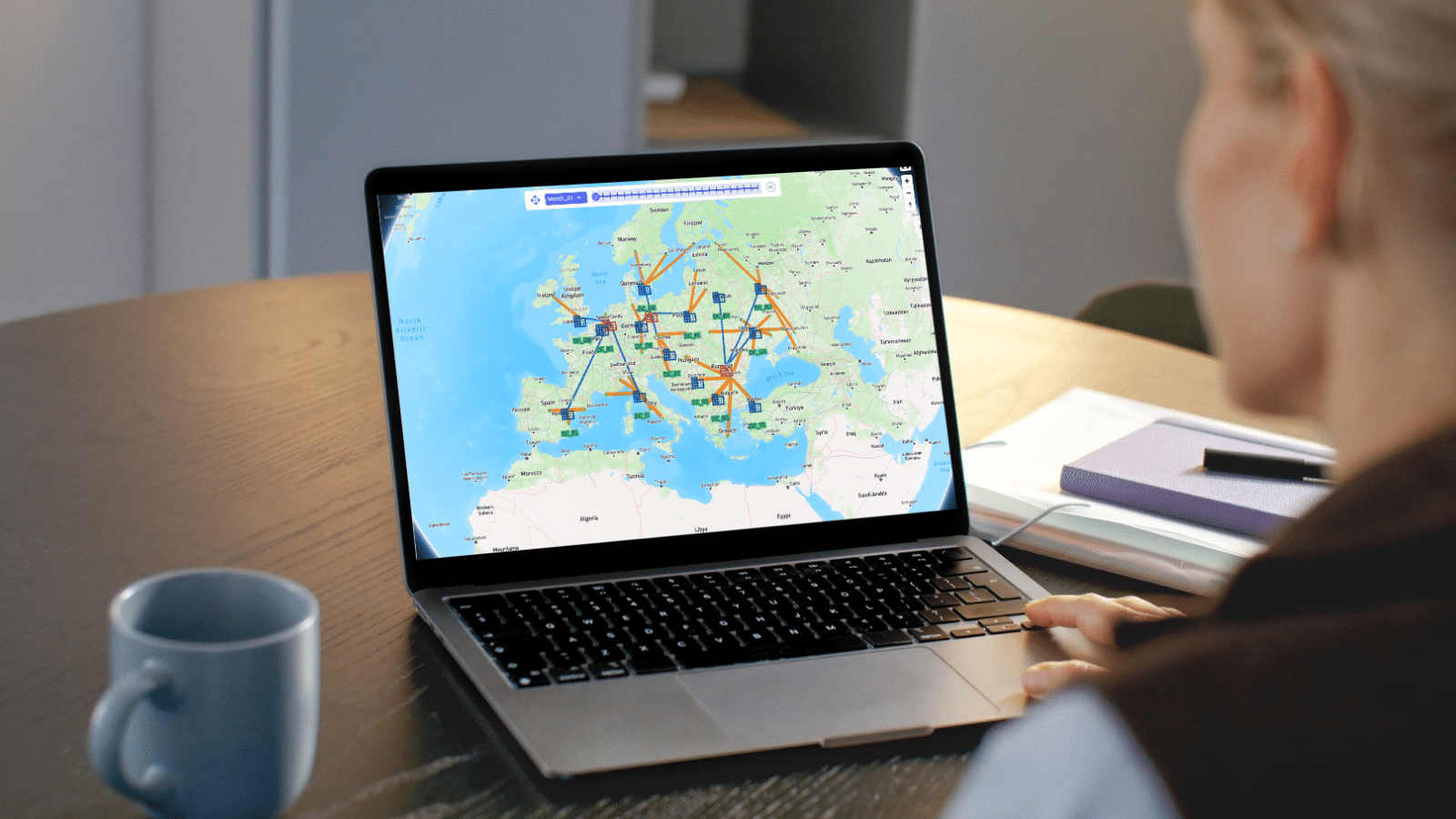

In a supply chain model, sourcing policies describe how network components create and order necessary materials. In Cosmic Frog, sourcing policies and rules appear in two different table categories:
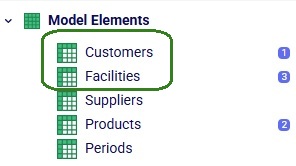
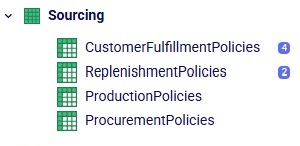
In this article, we describe how to use the model elements tables to define sourcing rules for customers and facilities. Specifically, we can decide if each location is single sourced, allows backorders, and/or allows partial fulfillment.
Single sourcing rules can be defined at both the order and line item level. Setting Single Source Orders to True for a location means that for each order placed by that location, every item in that order must come from a single source. Setting this value to False does not prohibit single sourcing, it just removes the requirement.
Setting Single Source Line Items to True only requires each individual line item to come from a single source. In other words, even if this is True, an individual order can have multiple sources, as long as each line item is single sourced.
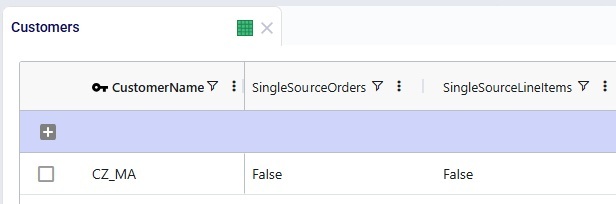
If Single Source Orders is set to True and Single Source Line Items is set to False, the Single Source Orders value takes precedence and whole orders need to be single sourced.
Defaults: when these fields are left blank, a value of False will be used - orders and line items can be split over multiple sources.
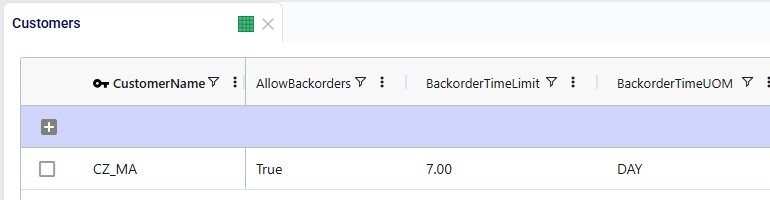
In case an order, or part of an order, cannot be filled from the stock available at the source when the order is placed, setting Allow Backorders to True lets the unfilled quantity wait as a backorder instead of being cancelled. It is filled when stock becomes available, provided this happens within the Backorder Time Limit. If the stock arrives after the due date, the order is filled late. If no stock arrives within the Backorder Time Limit, the unfilled quantity is cancelled.
Defaults:
We can also decide to allow partial fulfillment of orders or their line items. If Allow Partial Fill Orders is set to False, orders need to be filled in full. If set to True, then only filling part of an order on time (by the due date) is allowed. What happens with the unfulfilled part of the order depends on if backorders are allowed. If so, then the remaining quantity of a partially filled order can be satisfied in the future with additional shipments. If a time limit on backorders is set and is reached on a partially filled order, the remaining quantity will be cancelled. Partial Fill Orders and Partial Fill Line Items behave similarly to the single sourcing rules, where it is possible to for example allow partially filling orders (Allow Partial Fill Orders = False), but not partially filling line items (Allow Partial Fill Line Items = False). If Partial Fill Orders is set to True, then Partial Fill Line Items will also be forced to True, regardless of its value specified.
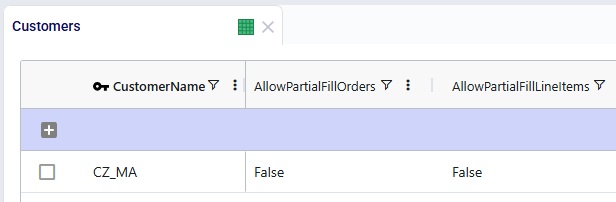
Defaults: when these fields are left blank, a value of True will be used - orders and line items are allowed to be partially filled.
The Customers, Facilities, and Suppliers tables also each contain a simulation-specific Queue Priority field, which is typically only used in more advanced Throg models. They can be used to give a customer, facility, or supplier a relative rank for prioritizing waiting orders. It only takes effect when a supporting queue-configuration table - such as Order Fulfillment Policies or Transportation Lane Queue Details - uses a value for the Queueing Priority Logic field that includes “By Location”; it has no effect with the default FIFO setting.
Consider the following simple model setup:
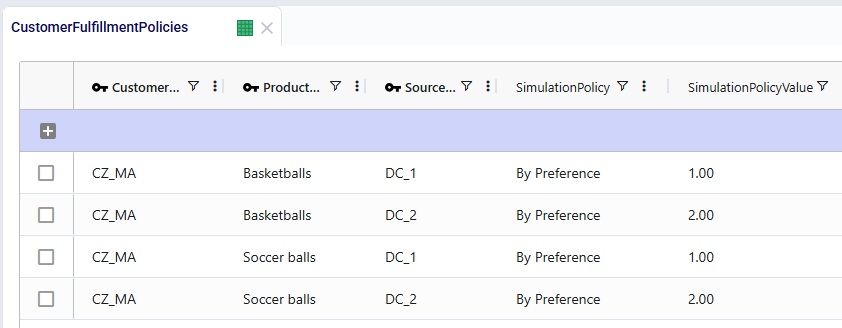
To illustrate how the sourcing rules and combinations of them affect how and when the 1 customer order with 2 line items is fulfilled, 32 scenarios were run with different settings and a few slight variations in inputs. The conventions used in the runs are:
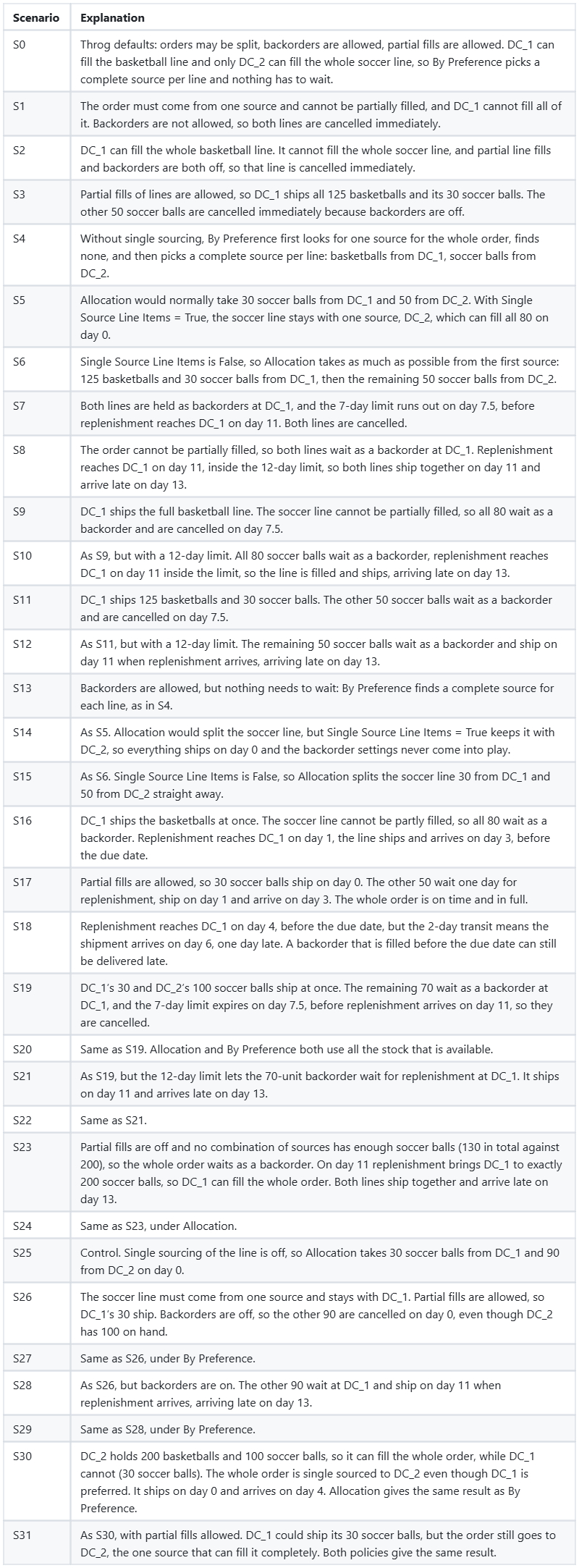
The runs are grouped together based on common settings. Unless a group below says otherwise, the order is for 125 basketballs and 80 soccer balls. Where a setting has the same value in every row of a group, it is stated in the group’s introduction instead of in a column. Further below, the outcomes of all scenarios are also briefly explained in one table.
The Simulation Order Report and Simulation Shipment Report output tables are used to understand the outcomes of each scenario. In the order report, we learn when orders occur ("Drop"), and when they are filled, backordered or cancelled. The shipment report tells us when a shipment leaves its origin and arrives at its destination along with the details of which product is being moved and the quantity.
Every Customers setting is blank. The effective defaults are: Single Source Orders False, Single Source Line Items False, Allow Backorders True, Backorder Time Limit unlimited, Allow Partial Fill Orders True, Allow Partial Fill Line Items True.

Allow Backorders is False and Backorder Time Limit is blank in all six, so anything that cannot be filled from stock at the start is cancelled immediately. Policy is shown as BP/AL where Single Source Orders is True, because By Preference and Allocation behave the same there.
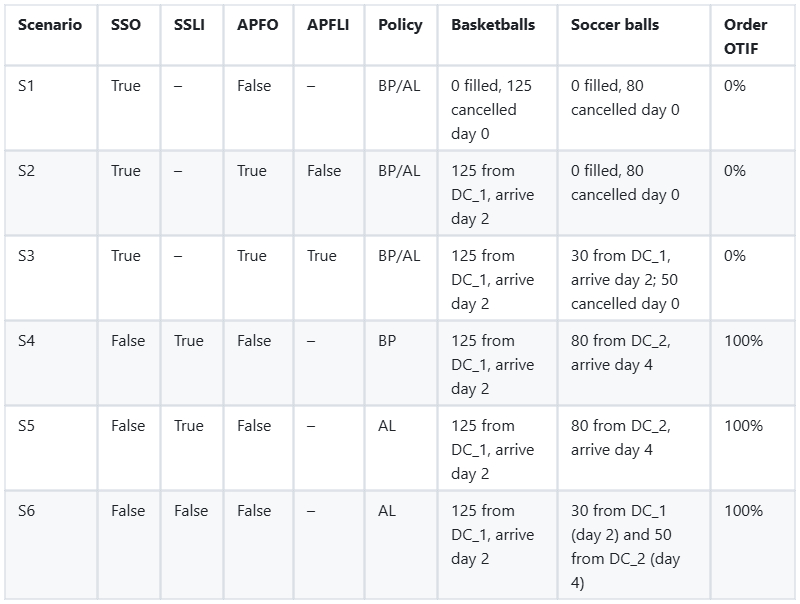
Single Source Orders and Allow Backorders are True in all of them, so the whole order must come from one source. Policy is BP/AL: By Preference and Allocation behave the same here. Each 7-day scenario is followed by its 12-day counterpart: with 7 days the backorder is cancelled, and with 12 days it is filled late.
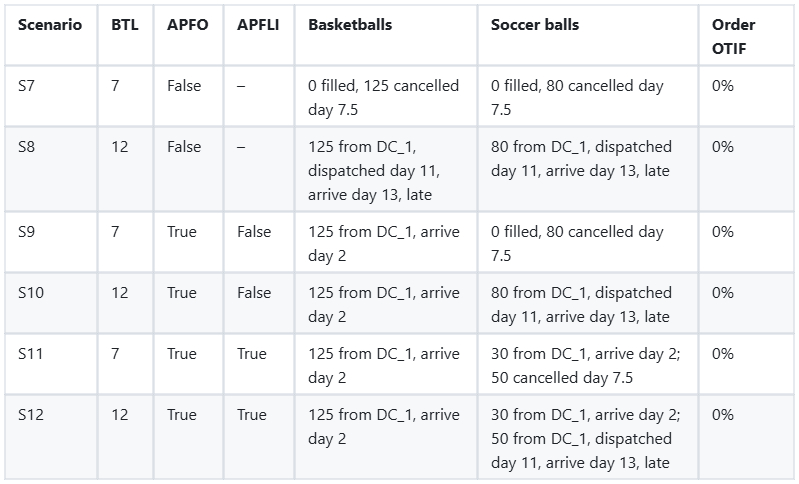
Single Source Orders is False, Allow Backorders is True, Backorder Time Limit is 7 and both partial-fill settings are False in all three. These repeat S4 to S6 with backorders switched on. Nothing has to wait, so the backorder settings never come into play and the results are the same.
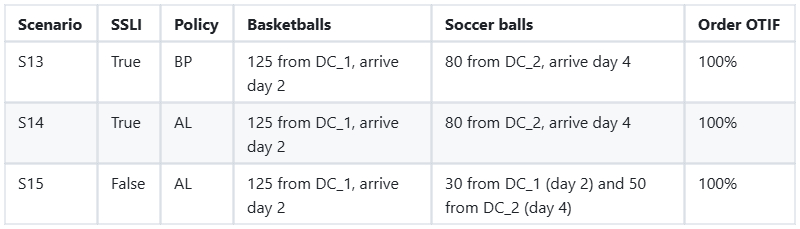
Single Source Orders, Allow Backorders and Allow Partial Fill Orders are True and Backorder Time Limit is 12 in all three. Policy is BP/AL. The soccer replenishment to DC_1 is made faster by shortening the MFG_1 to DC_1 transit time, so the backordered soccer balls become available earlier. Compare S10 and S12 (replenishment arrives on day 11) withS16 and S17 (day 1) and S18 (day 4).
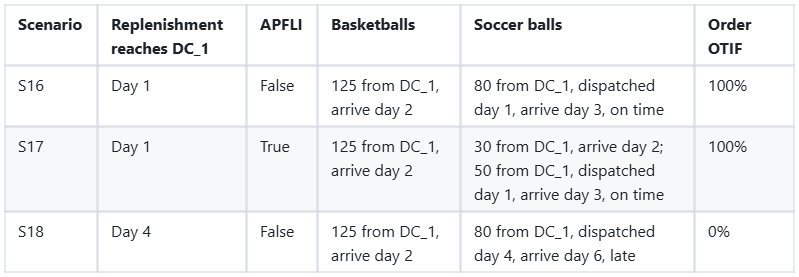
Soccer demand is raised from 80 to 200, above the 130 balls on hand in DC_1 and DC_2 together, so part of the soccer line has to be backordered even though the order may be split across sources. Single Source Orders is False, Single Source Line Items is blank and Allow Backorders is True in all of them. Basketball demand stays at 125.
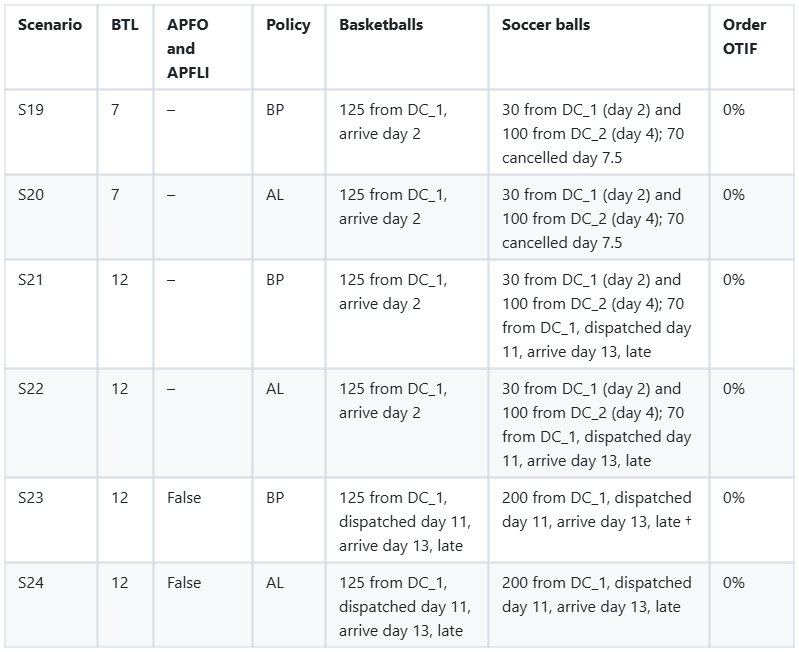
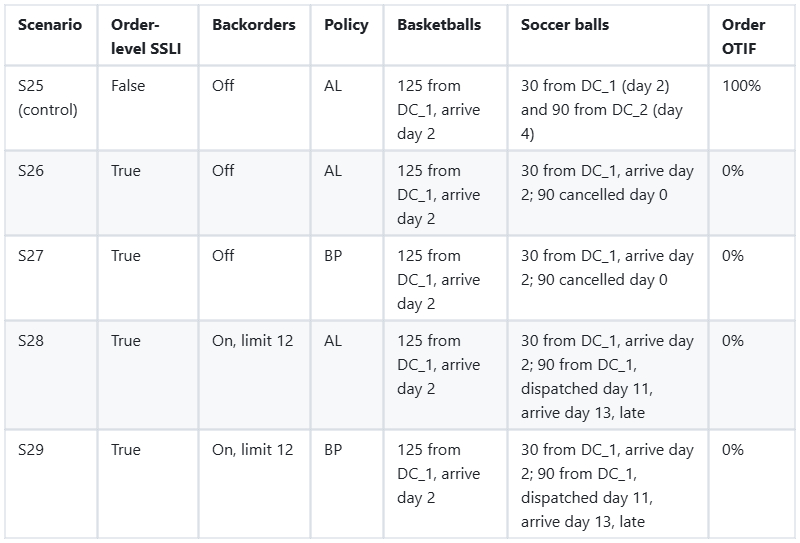
Soccer demand is 120: DC_1 has 30 and DC_2 has 100, so neither can fill the line alone, but together they can. Basketball demand stays at 125. In S26 to S29 Single Source Line Items is set to True, and S25 is the control with it set to False. Single Source Orders is False and both partial-fill settings are blank in all of them.
DC_2’s initial basketball inventory is raised from 25 to 200, so DC_2 can fill the whole order while DC_1 still cannot. Single Source Orders is True, Allow Backorders is False and Backorder Time Limit is blank in both. Each scenario was run with both By Preference and Allocation, and the results were identical.

At an overall level, neither DC can fill the whole order on its own: DC_1 is short of soccer balls and DC_2 is short of basketballs. Where the order must stay with one source, it therefore falls back to the preferred source, DC_1. Details by scenario:
Please do not hesitate to reach out to our Support team, support@optilogic.com, in case of questions or feedback.

In a supply chain model, sourcing policies describe how network components create and order necessary materials. In Cosmic Frog, sourcing policies and rules appear in two different table categories:
In this article, we describe how to use the model elements tables to define sourcing rules for customers and facilities. Specifically, we can decide if each location is single sourced, allows backorders, and/or allows partial fulfillment.
Single sourcing rules can be defined at both the order and line item level. Setting Single Source Orders to True for a location means that for each order placed by that location, every item in that order must come from a single source. Setting this value to False does not prohibit single sourcing, it just removes the requirement.
Setting Single Source Line Items to True only requires each individual line item to come from a single source. In other words, even if this is True, an individual order can have multiple sources, as long as each line item is single sourced.
If Single Source Orders is set to True and Single Source Line Items is set to False, the Single Source Orders value takes precedence and whole orders need to be single sourced.
Defaults: when these fields are left blank, a value of False will be used - orders and line items can be split over multiple sources.
In case an order, or part of an order, cannot be filled from the stock available at the source when the order is placed, setting Allow Backorders to True lets the unfilled quantity wait as a backorder instead of being cancelled. It is filled when stock becomes available, provided this happens within the Backorder Time Limit. If the stock arrives after the due date, the order is filled late. If no stock arrives within the Backorder Time Limit, the unfilled quantity is cancelled.
Defaults:
We can also decide to allow partial fulfillment of orders or their line items. If Allow Partial Fill Orders is set to False, orders need to be filled in full. If set to True, then only filling part of an order on time (by the due date) is allowed. What happens with the unfulfilled part of the order depends on if backorders are allowed. If so, then the remaining quantity of a partially filled order can be satisfied in the future with additional shipments. If a time limit on backorders is set and is reached on a partially filled order, the remaining quantity will be cancelled. Partial Fill Orders and Partial Fill Line Items behave similarly to the single sourcing rules, where it is possible to for example allow partially filling orders (Allow Partial Fill Orders = False), but not partially filling line items (Allow Partial Fill Line Items = False). If Partial Fill Orders is set to True, then Partial Fill Line Items will also be forced to True, regardless of its value specified.
Defaults: when these fields are left blank, a value of True will be used - orders and line items are allowed to be partially filled.
The Customers, Facilities, and Suppliers tables also each contain a simulation-specific Queue Priority field, which is typically only used in more advanced Throg models. They can be used to give a customer, facility, or supplier a relative rank for prioritizing waiting orders. It only takes effect when a supporting queue-configuration table - such as Order Fulfillment Policies or Transportation Lane Queue Details - uses a value for the Queueing Priority Logic field that includes “By Location”; it has no effect with the default FIFO setting.
Consider the following simple model setup:
To illustrate how the sourcing rules and combinations of them affect how and when the 1 customer order with 2 line items is fulfilled, 32 scenarios were run with different settings and a few slight variations in inputs. The conventions used in the runs are:
The runs are grouped together based on common settings. Unless a group below says otherwise, the order is for 125 basketballs and 80 soccer balls. Where a setting has the same value in every row of a group, it is stated in the group’s introduction instead of in a column. Further below, the outcomes of all scenarios are also briefly explained in one table.
The Simulation Order Report and Simulation Shipment Report output tables are used to understand the outcomes of each scenario. In the order report, we learn when orders occur ("Drop"), and when they are filled, backordered or cancelled. The shipment report tells us when a shipment leaves its origin and arrives at its destination along with the details of which product is being moved and the quantity.
Every Customers setting is blank. The effective defaults are: Single Source Orders False, Single Source Line Items False, Allow Backorders True, Backorder Time Limit unlimited, Allow Partial Fill Orders True, Allow Partial Fill Line Items True.
Allow Backorders is False and Backorder Time Limit is blank in all six, so anything that cannot be filled from stock at the start is cancelled immediately. Policy is shown as BP/AL where Single Source Orders is True, because By Preference and Allocation behave the same there.
Single Source Orders and Allow Backorders are True in all of them, so the whole order must come from one source. Policy is BP/AL: By Preference and Allocation behave the same here. Each 7-day scenario is followed by its 12-day counterpart: with 7 days the backorder is cancelled, and with 12 days it is filled late.
Single Source Orders is False, Allow Backorders is True, Backorder Time Limit is 7 and both partial-fill settings are False in all three. These repeat S4 to S6 with backorders switched on. Nothing has to wait, so the backorder settings never come into play and the results are the same.
Single Source Orders, Allow Backorders and Allow Partial Fill Orders are True and Backorder Time Limit is 12 in all three. Policy is BP/AL. The soccer replenishment to DC_1 is made faster by shortening the MFG_1 to DC_1 transit time, so the backordered soccer balls become available earlier. Compare S10 and S12 (replenishment arrives on day 11) withS16 and S17 (day 1) and S18 (day 4).
Soccer demand is raised from 80 to 200, above the 130 balls on hand in DC_1 and DC_2 together, so part of the soccer line has to be backordered even though the order may be split across sources. Single Source Orders is False, Single Source Line Items is blank and Allow Backorders is True in all of them. Basketball demand stays at 125.
Soccer demand is 120: DC_1 has 30 and DC_2 has 100, so neither can fill the line alone, but together they can. Basketball demand stays at 125. In S26 to S29 Single Source Line Items is set to True, and S25 is the control with it set to False. Single Source Orders is False and both partial-fill settings are blank in all of them.
DC_2’s initial basketball inventory is raised from 25 to 200, so DC_2 can fill the whole order while DC_1 still cannot. Single Source Orders is True, Allow Backorders is False and Backorder Time Limit is blank in both. Each scenario was run with both By Preference and Allocation, and the results were identical.
At an overall level, neither DC can fill the whole order on its own: DC_1 is short of soccer balls and DC_2 is short of basketballs. Where the order must stay with one source, it therefore falls back to the preferred source, DC_1. Details by scenario:
Please do not hesitate to reach out to our Support team, support@optilogic.com, in case of questions or feedback.